
The Central Market (Agora)
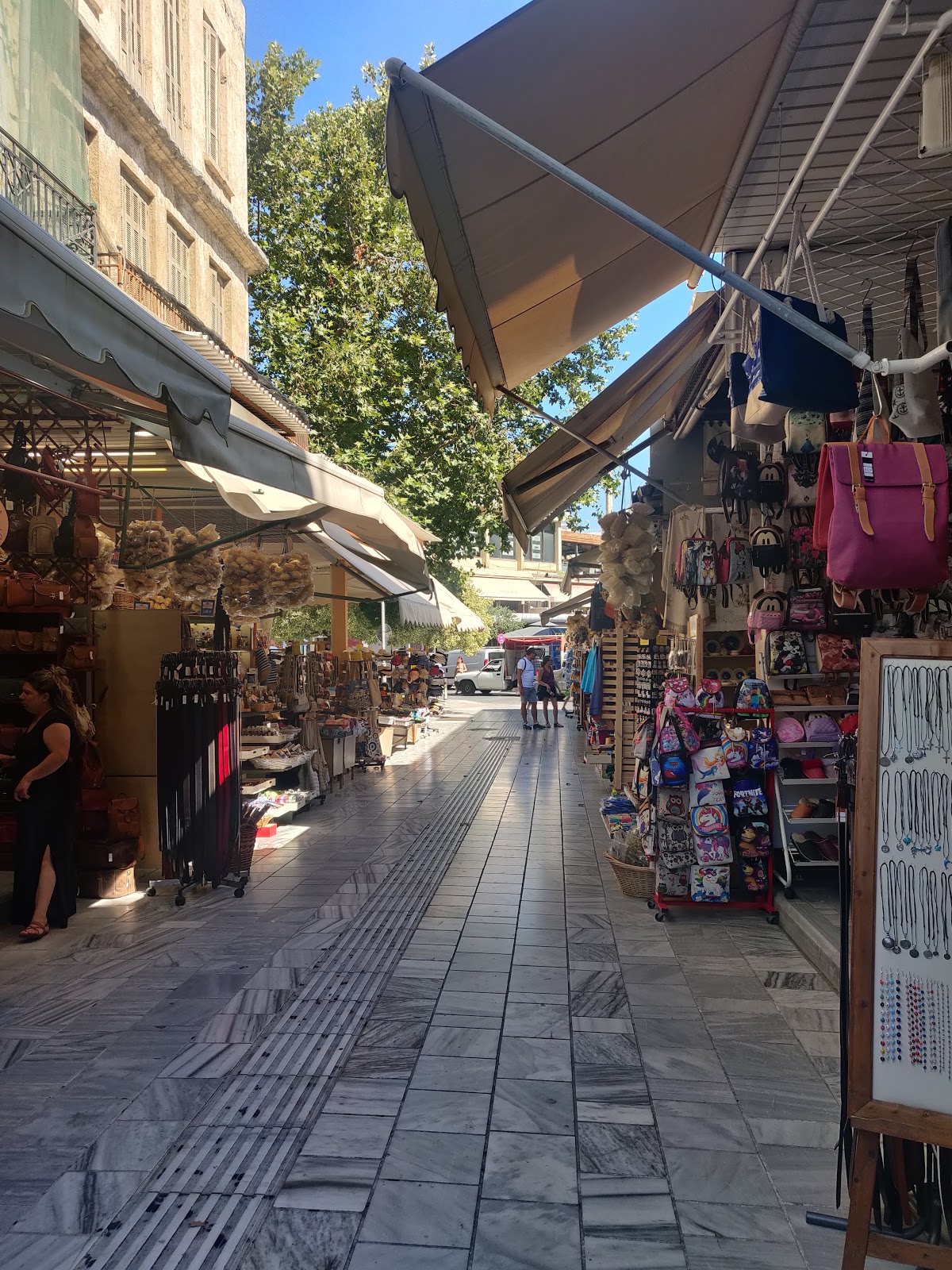
A stroll along 25th August Street, at the heart of the Agora, is a dive into the vibrant, bustling, and fragrant soul of Cretan life. This covered market street is a living symphony for the senses, a tradition where trade, conversation, and culture coexist in perfect harmony. The air is rich with the scents of mountain and sea: piles of wild herbs, barrels of glossy olives, wheels of fresh cheese, and the day’s catch proudly displayed on ice.
More than just a place to shop, the Agora is a theater of everyday life. Sellers tease with playful Cretan humor, housewives bargain with practiced skill, and the clatter of coffee cups spills from tiny cafés. Here, you can taste salty mizithra cheese, savor golden-thick honey, or enjoy a strong raki coffee. It is an authentic, unpretentious immersion into the island’s soul, where every purchase connects you to the land and its passionate people.

Morosini Fountain (Liontaria)
At the very heart of the city, where the main arteries meet, lies an oasis of cool stone and crystal-clear water: the Morozeni Fountain. Built in 1628 by the Venetian governor Francesco Morozeni, it was a technical marvel that brought running water from the mountains into the city’s urban core for the first time. Its elegant basin rests upon four majestic lions, slightly worn by time, from whose mouths water has flowed for centuries.
The square around it, officially Eleftherios Venizelos Square but known to all simply as “Lion Square,” is the city’s living room. Cafés spill around its edges, and people always gather beneath the shade of the plane trees. Sitting here with a Greek coffee, listening to the eternal whisper of the fountain amidst the city’s hum, is to participate in a ritual that has for generations rejuvenated and united the people of Heraklion.
The Historical Museum of Crete
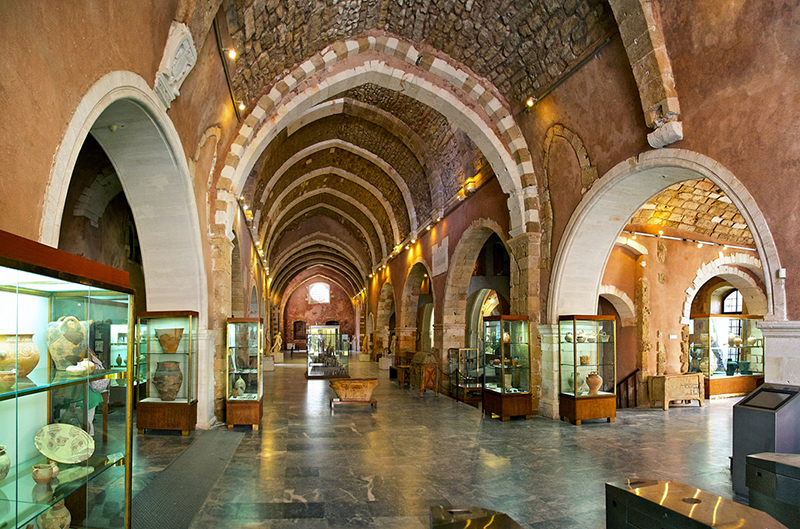
While the Archaeological Museum tells the story of mythical antiquity, the Historical Museum weaves the colorful and complex fabric of Crete, from the early Christian era to the turbulent 20th century. Housed in an attractive neoclassical building, its collections testify to the island’s resilient, artistic, and revolutionary spirit. Here, the stories of Byzantine icons, Venetian rule, Ottoman occupation, and the fiery struggle for union are told.
Among its treasures are the only two surviving original works by the great Cretan painter Domenikos Theotokopoulos (El Greco) on the island, linking Crete to the heights of the European Renaissance. Equally moving are the exhibitions on the Cretan resistance during World War II. The museum captures not only events but the very soul of a people their faith, their art, and their unbroken will for freedom making the island’s vibrant present deeply understood.

Saint Catherine's Church & the Sinaites
Hidden in a quiet square, this modest 16th-century church was once the heart of a remarkable spiritual and artistic flourishing. It functioned as an annex of the great Sinai Monastery and hosted a distinguished school where theology, philosophy, music, and literature were taught. Among its students, known as the “Cretan Sinaites,” was the young Domenikos Theotokopoulos, before he departed for Venice and Spain to become El Greco.
Today, the church operates as a museum, showcasing exquisite examples of Cretan Byzantine and post-Byzantine iconography from the 15th and 16th centuries — the renowned “Cretan School.” The icons here are not merely religious art; they are masterpieces of emotion and technique, revealing the unique fusion of Eastern Orthodox tradition with emerging influences from the Italian Renaissance. A serene place that whispers of a time when Heraklion was a beacon of culture and knowledge.
The Bembo Fountain & The "Istanbul" Door
Scattered throughout the modern city are poignant, solitary remnants of the vast Venetian walls that once encircled and protected Heraklion. The Bempo Fountain, built into a corner of Kornaros Square, is one such fragment. Constructed in 1588 from recycled ancient and Venetian materials, it incorporates a headless Roman statue as a support — a striking example of historical recycling. Its waters were once considered the sweetest in the city.
A little further along the bustling Dimokratias Avenue stands the enigmatic “Gate of Constantinople,” also known as the “Gate of Chania.” This solitary, elegant arched gate, isolated amidst modern traffic, is the only remaining fragment of a fortress that belonged to the same defensive system. These forgotten fragments are poetic encounters — they invite you to pause, to imagine the vast scale of the lost fortifications, to envision the city they once protected, and to touch stones that have silently witnessed the unfolding history of Heraklion.
